As of April 2026, the manufacturing sector is navigating a fragile expansion. The swift rise of “AI” has already shifted the manufacturing landscape. That structural shift has major implications for jobs, products, and stocks.
While the industry has largely emerged from the stagnation of late 2025, it is currently defined by a “tug-of-war” between strong domestic demand and significant cost pressures.
About This Page
Stockmark101.com is a free educational site focused on explaining how stocks and markets work. Company write-ups reflect general market commentary and publicly available information and are used to illustrate business fundamentals and market behavior — not personalized investment advice.
Fragile Manufacturing Growth in Expansion Territory
The ISM Manufacturing PMI has hovered around 52.4 to 52.7 in early 2026, marking a consistent expansionary trend for the first time in nearly two years.
While this indicates growth, it is described as “fragile.” Roughly 13 of the 18 major manufacturing sectors are reporting growth, led by Chemical Products, Machinery, and Computer & Electronic Products.
The Price-Paid Surge
The most significant headwind in 2026 is the dramatic spike in input costs. The Prices Paid Index recently surged to 78.3, its highest level since the post-pandemic inflation peak of 2022.
This is driven by volatile energy costs and supply chain friction in the Middle East, forcing manufacturers to choose between absorbing costs or risking demand drops by raising prices.
Supply Chain Flexing Trumps Efficiency
The philosophy of “Just-in-Time” has been permanently replaced by “Permanently Flexible” supply chains.
Regionalization: Moving production closer to home (nearshoring) to mitigate geopolitical risks.
Scenario Modeling: Using AI to simulate trade disruptions or tariff shifts in real-time.
Supplier Diversification: Moving away from single-source reliance to avoid “bottleneck” shutdowns.
AI Transition: From Pilot to Profit
2026 is being hailed as the “Year of Proof-of-Value” for Artificial Intelligence. Companies are moving beyond experimenting with AI and are now embedding it into core workflows. Key applications include predictive maintenance (reducing downtime by up to 20%) and generative design, which allows for rapid prototyping of customized products.
The Skills-First Labor Shift
Despite a cooling broader job market, the manufacturing Employment Index remains in slight contraction, not due to a lack of work but a lack of qualified workers. The industry is seeing a massive shift in talent needs: Physical labor roles are being augmented by human-machine collaboration. There is a high premium on “tech-literate” graduates who can manage digital dashboards rather than just operate manual machinery.
M&A Momentum and Reshoring
Mergers and acquisitions (M&A) have rebounded in 2026. Instead of buying competitors for market share, manufacturers are using acquisitions to “buy” technology, specifically targeting companies with advanced automation or clean-energy capabilities. This coincides with a federal policy landscape that continues to incentivize domestic production through tax credits and industrial deregulation.
Mark Notes
The manufacturing sector is technologically advanced and optimistic. But it’s operating on thin profit margins — due to rising costs. While the broader economy has been sluggish, the sector is being propped up by heavy domestic investment in high-tech sectors. Capital is flowing heavily into semiconductors, data center infrastructure, and energy.
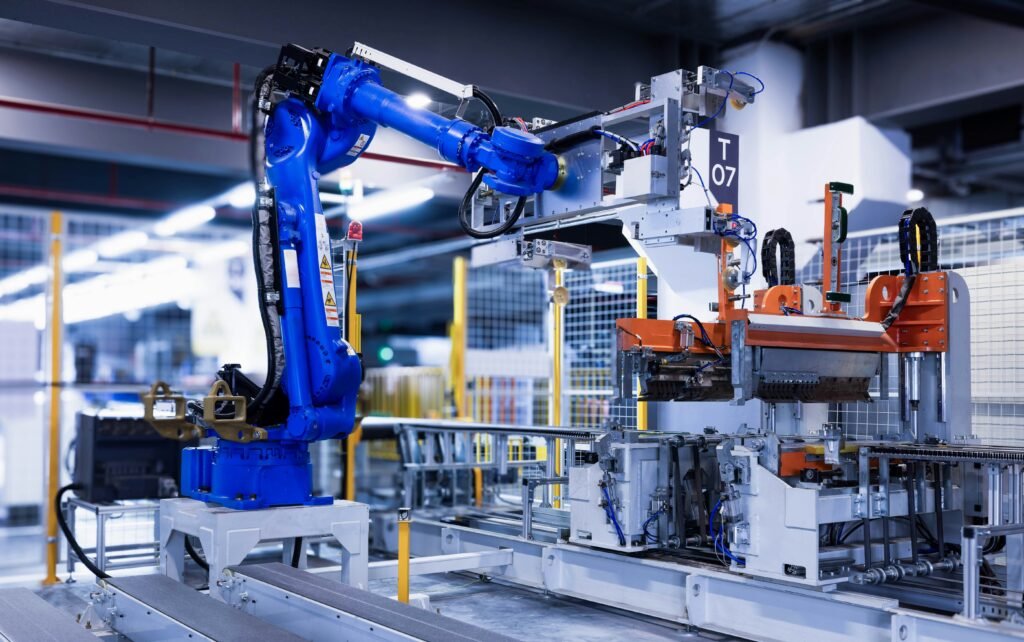
The focus has moved from “building more stuff” to “building the stuff that builds the future.” AI is being deployed as a “co-pilot” for workers rather than a replacement. The “rusty factory” image is effectively dead. US manufacturing now prioritizes STEM and IT skills.
This article is for general informational and educational purposes only. It is not intended as financial advice, investment guidance, or a recommendation to buy or sell any security. The content reflects publicly available information and broad market commentary. Readers should conduct their own research and consult a licensed financial professional before making investment decisions.
Leave a Reply