Artificial intelligence companies have attracted considerable attention during the current stock-market advance. At the same time, another asset has returned to the spotlight: gold.
After gaining about 70% in 2025 (its strongest annual performance since 1979)gold continued to rise and reached an all-time high of about $5,589 per ounce on January 28, 2026.
Gold subsequently declined and traded near $4,000 during July before rebounding. As of August 21, 2026, spot gold was trading near $4,624 per ounce. It remained below its January record but had gained approximately 11% over the preceding month and remained positive for 2026.
Gold’s performance is sometimes compared with major stock indexes to provide context. Over the six months following its January peak, gold and many gold-mining stocks trailed the broader stock market. Over the trailing year, however, gold outperformed both the S&P 500 (VOO) and the Nasdaq-100 (QQQ).
About This Page
Stockmark101.com is a free educational site focused on explaining how stocks and markets work. Company write-ups reflect general market commentary and publicly available information and are used to illustrate business fundamentals and market behavior — not to provide personalized investment advice.
Gold’s Historical Cycles
Gold experienced a lengthy advance from the early 2000s through 2011, including the period surrounding the Great Recession. It then entered a long period of consolidation and generally traded below its 2011 peak for several years.
Interest in other alternative assets, including cryptocurrencies, expanded during that period. However, gold prices were also affected by interest rates, inflation expectations, the strength of the U.S. dollar, investor demand, and central-bank activity.
Gold began breaking out of its previous trading range during early 2024. It surpassed $2,500 per ounce later that year and continued reaching new highs during 2025 and early 2026.
Market observers commonly describe this sustained advance as a gold bull market. A bull market can still include substantial corrections, volatility, and extended periods of weaker per formance.
Factors Affecting Gold Prices
Gold prices posted substantial gains in 2025 as trade tensions, tariff announcements, geopolitical uncertainty, and concerns about inflation and government debt increased interest in assets commonly viewed as stores of value.
Central-bank purchases were another source of demand. Central banks hold gold as part of their foreign-exchange reserves and may use it to diversify their exposure to currencies and government debt.
The World Gold Council reported that central banks remained net purchasers during 2026, although demand was running below its 2025 pace. Its central-bank survey also indicated that many reserve managers expected global official gold holdings to increase.
Several factors can influence gold prices:
- Central-bank purchases and sales
- Interest-rate expectations
- Inflation expectations
- Changes in the U.S. dollar
- Government debt and fiscal concerns
- Geopolitical developments
- Investment demand through funds and ETFs
- Jewellery and industrial demand
- Mine production and recycled-gold supply
Gold does not respond to these factors in a uniform or predictable way. For example, geopolitical uncertainty may increase safe-haven demand, but rising interest rates or a stronger dollar can place pressure on prices.
“HALO” Stocks Revisited
The “HALO” theme has received attention in 2026. HALO stands for Hard Assets: Low Obsolescence. See my May 18, 2026 post.
The term generally refers to established businesses connected with physical assets, infrastructure, energy, construction, transportation, commodities, or industrial equipment. These assets and services cannot be replaced as easily by new software or changing technology.
Caterpillar is one example. The company manufactures construction and mining equipment, engines, and industrial gas turbines. Its long operating history helps illustrate the “low obsolescence” part of the theme.
Gold and gold-mining companies can also fit within the hard-assets portion of HALO. Newmont Corporation (NEM), for example, is one of the world’s largest publicly traded gold-mining companies.
Gold-mining shares are influenced by gold prices, but they do not move in perfect alignment with the metal. Mining costs, production levels, reserve quality, political conditions, management decisions, debt, taxes, and currency movements can all affect their performance.
Gold miners weakened considerably after gold reached its January high, even as conflict in the Middle East contributed to higher oil prices. Although gold and oil can both respond to inflation or geopolitical concerns, they do not consistently move together.
Comparing Ways to Gain Gold Exposure
There are several ways market participants obtain exposure to gold. Each has different characteristics and risks.
Physical Gold
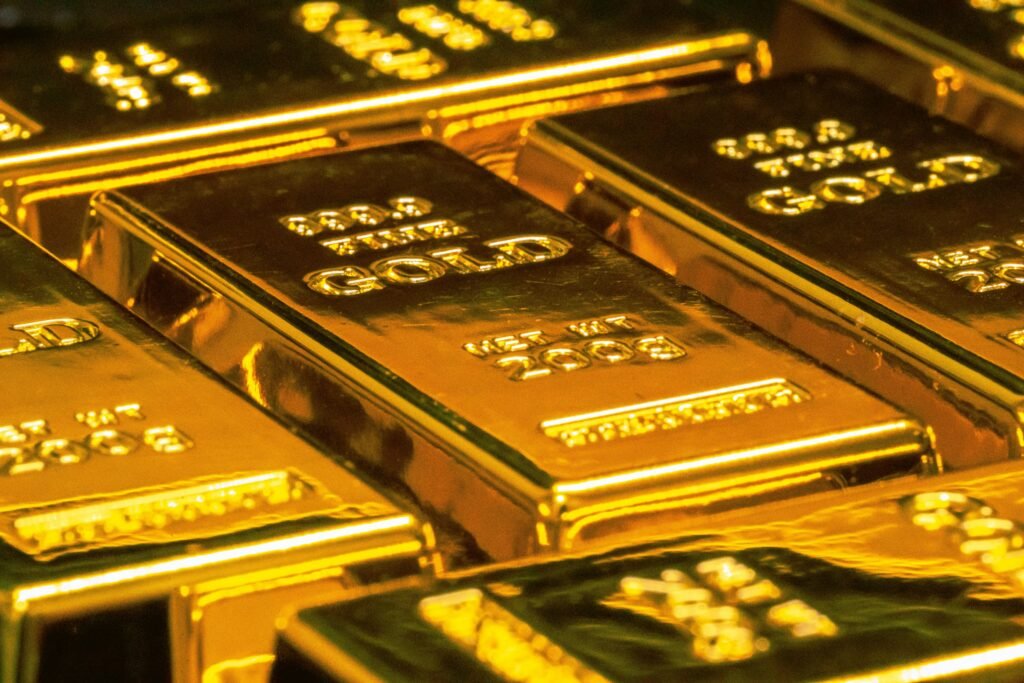
Physical gold can include bullion bars and coins. Its value is directly connected to the metal, but ownership may involve dealer premiums, storage expenses, insurance, security concerns, and differences between buying and selling prices.
Gold-Tracking Funds
A gold-tracking fund such as SPDR Gold Shares (GLD) provides market exposure to gold without requiring an investor to personally store the metal.
The fund’s value is designed to reflect gold prices, less applicable expenses. ETF shares can be bought and sold through a brokerage account, but their market price can fluctuate and may not perfectly match movements in spot gold.
Gold-Mining Companies
A gold-mining stock represents ownership in an operating company rather than direct ownership of gold. Like other businesses, a mining company generates revenue and incurs operating expenses. Its results depend on the difference between the price it receives for gold and the cost of finding, developing, and operating its mines.
Higher gold prices can expand a miner’s profit margins when production and costs remain stable. Lower gold prices, production problems, or rising expenses can reduce those margins. This operating sensitivity can cause mining shares to move more sharply than gold in either direction.
Newmont’s Recent Results
Newmont Corporation (NEM) is the world’s largest gold miner. The company reported second-quarter 2026 net income of $2.2 billion, or $2.06 per diluted share, compared with $1.85 per share in the year-earlier quarter.
Quarterly revenue reached $6.12 billion, an increase of approximately 15% from $5.32 billion a year earlier. Newmont’s average realized gold price was $4,414 per ounce, compared with $3,320 in the prior-year quarter.
Newmont’s results demonstrate why gold-mining stocks should not be viewed as identical substitutes for physical gold. Even when gold prices are favorable, operating performance and production costs remain important.
Mark Notes
Commodities and commodity-related stocks can experience large price movements in both directions. Gold-mining shares may be even more volatile than gold because their earnings are affected by both metal prices and business operations.
During the recent one-month rebound, funds representing large gold miners, such as GDX, and junior gold miners, such as GDXJ, outperformed both gold and the S&P 500. Over the preceding six months, however, those funds experienced substantial weakness following gold’s January peak.
Gold’s advance since 2024 can be described as a bull market based on its sustained rise and series of record highs. That does not mean the price will move upward continuously. Corrections, pullbacks, and changes in market leadership occur during both bull and bear markets.
The gold advance that began in the early 2000s lasted for nearly a decade, but the duration of one historical cycle does not determine the length of another. The current cycle could continue, pause, or reverse as interest rates, currencies, central-bank demand, geopolitical conditions, and investor sentiment change.
Gold, gold-tracking funds, large mining companies, and junior miners provide different forms of exposure. Understanding those differences is more useful than assuming that all gold-related investments will perform the same way.
This content is for educational purposes only and does not constitute financial advice or a recommendation to purchase gold, mining stocks, ETFs, or any other investment. Commodity prices and mining shares can be highly volatile. Past performance does not guarantee future results.
Leave a Reply