Semiconductors have played a central role in recent technology trends, particularly as investment in artificial intelligence has expanded.
Stocks are back on the upswing. Pullbacks and corrections are common in every bull market. The recent recovery is taking place against a backdrop of a resilient economy, rising productivity, and an AI boom that’s very much alive and well.
Semiconductors are soaring. So are memory stocks, data center builders, and virtually all things AI related. The amount of investment in AI has already dwarfed that of the dot-com era. And the unprecedented spending and innovation are expected to last for years to come. And with it, the opportunity to transform one’s portfolio.
About This Page
Stockmark101.com is a free educational site focused on explaining how stocks and markets work. Company write-ups reflect general market commentary and publicly available information and are used to illustrate business fundamentals and market behavior — not personalized investment advice.
Image Source: StockCharts
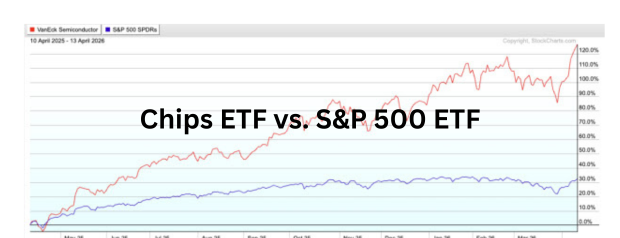
Chips Thrive Despite Market Woes
The stock market’s 1Q was the worst quarter since 2022, as the war in Iran sent oil soaring and stocks plunging. In addition to the war, investors also had to contend with tariff-related uncertainty and concerns over disruptions in certain areas caused by artificial intelligence.
One area of the market that continues to do well is semiconductors. The iShares Semiconductor ETF (SOXX) is up more than 28% year to date, after surging 41% in 2025 and more than 1,000% in the past 10 years, significantly outperforming the broader indexes.
These companies provide the “picks and shovels” for the AI gold rush. Chips, the fundamental building blocks of computation, have become integral to everything from smartphones and cars to laptops, PCs, video games, and data centers.
Mega Deals in the Chip Sector
Several recent mega deals have further boosted sentiment for chip stocks. Intel’s shares surged last week after it announced a partnership with Elon Musk on his Terafab project. Intel would build custom chips for SpaceX, xAI, and Tesla (TSLA). Intel also received a boost when NVIDIA announced a $5 billion investment and the U.S. government’s 10% stake.
Earlier in February, Meta announced plans to purchase AMD chips to power its massive AI workloads over the next five years. This deal is potentially valued at over $100 billion.
Chips vs. Software
The iShares software ETF (IGV) is down about 28% this year, compared with SOXX’s 28% gain, as investors are concerned that AI could replace many enterprise software tools for legal services, data analytics, and customer-facing functions. The sell-off followed the launch of Anthropic’s new AI productivity tools. In addition to software companies, private credit companies that have extended loans to these companies came under heavy selling pressure.
Is the AI Trade in a Bubble?
Some of the recent AI deals have raised concerns due to their circular structure, with critics comparing them to vendor-financing arrangements seen during the dot-com bubble. Critics have also warned about a potential AI bubble, suggesting that NVIDIA’s large investments in OpenAI and other AI startups are designed to boost demand for its own chips.
Unlike the dot-com bubble, however, the leading players in the race toward artificial general intelligence today are highly profitable, cash-rich mega-cap companies investing hundreds of billions to stay ahead. For them, the greater risk lies in underinvesting and losing the race, not in overspending.
Mark Notes
NVIDIA (NVDA) still dominates the AI trade. CEO Jensen Huang announced that the company now expects to secure up to $1 trillion in chip orders for its next-generation AI platforms by 2027, versus earlier guidance of $500 billion by the end of 2026.
But now, many other chip makers and memory stocks are outperforming NVIDIA. The industry is shifting toward monetizing AI applications, and the emphasis has moved from training to inference, where models generate responses to user queries in real time. In this segment, NVIDIA faces growing competition from rivals offering more affordable, customizable chips optimized for inference workloads.
See my previous Company Overview posts on NVIDIA (NVDA), Broadcom (AVGO), and Micron Technology (MU).
Micron Technology: A Memory Chip Leader
NVIDIA: Chip Designer to AI Powerhouse
Broadcom: A Moderate Growth Chip Maker
This article is for general informational and educational purposes only. It is not intended as financial advice, investment guidance, or a recommendation to buy or sell any security. The content reflects publicly available information and broad market commentary. Readers should conduct their own research and consult a licensed financial professional before making investment decisions.
Leave a Reply