When global shipping routes face uncertainty, attention often shifts to the naval systems that help support and protect them.
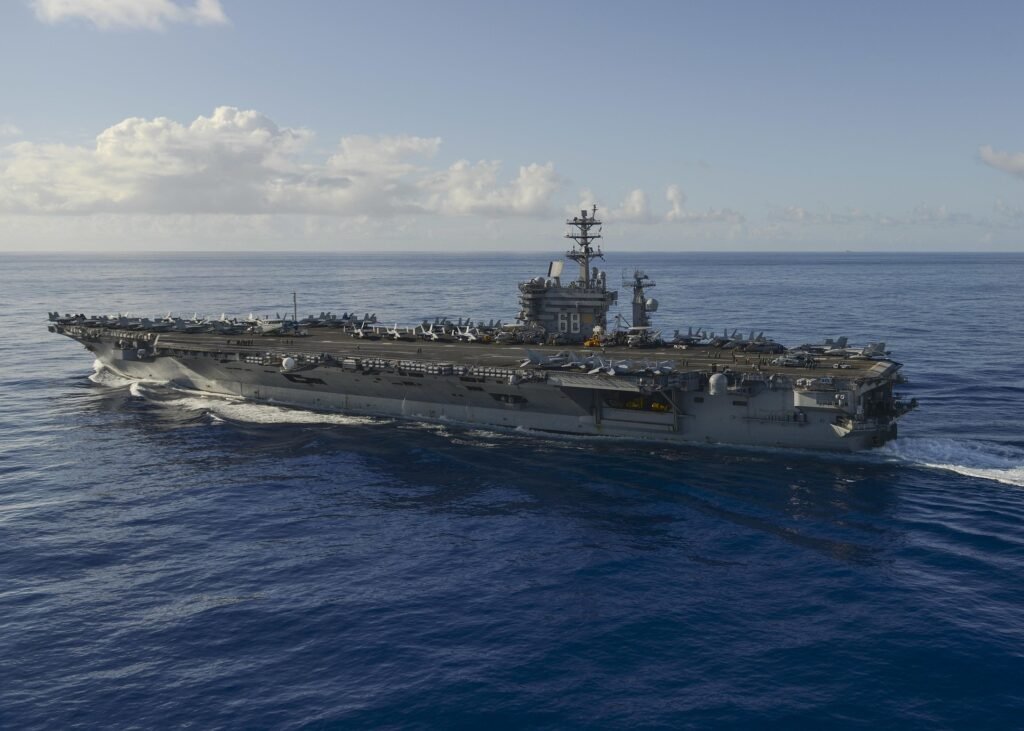
Huntington Ingalls (HII) designs, builds, and maintains nuclear-powered ships, such as aircraft carriers and submarines, and non-nuclear ships, such as surface combatants, expeditionary warfare/amphibious assault ships, and coastal defense surface ships for the U.S. Navy and Coast Guard. Huntington one of the two primary U.S. shipbuilders, with more than 100 years of experience and based in Newport News, VA.
About This Page
Stockmark101.com is a free educational site focused on explaining how stocks and markets work. Company write-ups reflect general market commentary and publicly available information and are used to illustrate business fundamentals and market behavior — not personalized investment advice.
| Price | $379 | Catergory | Moderate | |
| Market Cap | $14.9B | Dividend | $5.52 | 1.46% |
| P/E Ratio | 24.64 | Analyst Avg | 1-Yr Target | $407 |
| Consensus EPS Estimate | 1Q | 2Q | 3Q | 4Q |
| 2027 | 4.29E | 4.80E | 4.84E | 5.41E |
| 2026 | 3.67E | 4.20E | 4.37E | 4.78E |
| 2025 | 3.79A | 3.86A | 3.68A | 4.04A |
Historical Volatility categories (Conservative, Moderate, and Aggressive) are based on beta, which measures a stock’s historical price volatility relative to the overall market. Company metrics are current as of the publication date. Historical Revenue and Annual EPS reflect reported fiscal-year results. All information is provided for educational purposes only and should not be considered investment advice or recommendations.
Keys for Success
During 4Q25, revenue increased 15.7%, with all three business segments posting growth. The company made steady progress across its major shipbuilding programs. More than 70% of the active U.S. Navy fleet consists of Huntington Ingalls ships. The company delivered its second Flight III destroyer, DDG 128 Ted Stevens, launched DDG 129 Jeremiah Denton, authenticated the keel of DDG 135 Thad Cochran, and completed sea trials for DDG 1000 Zumwalt.
Thanks to the strong demand for Huntington Ingalls’ products, its order value remains solid. The value of the company’s new contract awards, which it won in 2025, was a solid $16.9 billion. This resulted in a record backlog of $53.14 billion as of Dec. 31, 2025, of which approximately $31.99 billion was funded. Such a significant backlog count boosts the company’s prospects for solid revenue generation in the coming years.
In December 2025, the U.S. Navy announced its “golden fleet,” featuring the Trump-class battleship and a new frigate. The company also expanded its capabilities in autonomous and unmanned systems through several new partnerships. The launch of the ROMULUS family of unmanned surface vessels showcases the company’s ability to blend in-house technology with partner expertise. It also signed a memorandum of agreement with HD Hyundai Heavy Industries to explore future collaboration opportunities.
Thanks to the strong demand for Huntington Ingalls’ products, its order value remains solid. The value of the company’s new contract awards, which it won in 2025, was a solid $16.9 billion. This resulted in a record backlog of $53.14 billion as of Dec. 31, 2025, of which approximately $31.99 billion was funded. Such a significant backlog count boosts the company’s prospects for solid revenue generation in the coming years.
In January 2026, President Donald Trump proposed a significant increase in U.S. defense spending, targeting annual military outlays of about $1.5 trillion by 2027, up from the roughly $901 billion defense budget approved for fiscal 2026, subject to congressional approval. This should bode well for Huntington Ingalls.
Huntington Ingalls has a current ratio of 1.13, which is greater than 1, indicating that the company has sufficient current assets to cover its short-term debt obligations. Such impressive financial ratios illustrate the strength of the company’s financial position. Free cash flow nearly doubled compared to Q4 2024. It increased its quarterly dividend by 2.2%, paying $1.38 per share in 4Q25.
Keys for Concern
Huntington Ingalls is heavily dependent on its subcontractors and the availability and pricing of raw materials and components. Disruptions, cost increases, delays, sole-source dependencies, or supplier non-compliance can raise contract costs, delay deliveries, and hinder the company’s ability to meet customer obligations. The company has been facing significant performance challenges in constructing aircraft carriers recently due to workforce issues, supply chain disruptions, and infrastructure constraints. About 45% of the company’s workforce is covered by 13 collective bargaining agreements that must be renegotiated. Steel is a major input, and the company must still import certain specialty alloys and grades subject to 25% import tariffs.
Mark Notes
Huntington Ingalls provides an example of a company involved in long-cycle infrastructure tied to national defense and maritime operations. Its activities span traditional shipbuilding as well as emerging areas such as autonomous and unmanned systems.
Recent results have reflected backlog growth, program execution, and broader defense-related activity, while also highlighting the operational complexity involved in large-scale, multi-year projects.Huntington Ingalls provides an example of a company involved in long-cycle infrastructure tied to national defense and maritime operations. Its activities span traditional shipbuilding as well as emerging areas such as autonomous and unmanned systems.
Recent results have reflected backlog growth, program execution, and broader defense-related activity, while also highlighting the operational complexity involved in large-scale, multi-year projects. Huntington Ingalls has seen a nice streak of beating earnings estimates, especially over the past two reports. The average upside surprise for the last two quarters was 10.23%. The company also pays a dividend of $5.52 (1.46%).
New to investing? These explanations may help:
Semiconductors: Thriving in a Turbulent Market
Growth vs. Value: Why Some Stocks Move So Differently
This article is for general informational and educational purposes only. It is not intended as financial advice, investment guidance, or a recommendation to buy or sell any security. The content reflects publicly available information and broad market commentary. Readers should conduct their own research and consult a licensed financial professional before making investment decisions.
Leave a Reply