When most people think of artificial intelligence, they picture data centers and computer chips. Few think about the heavy equipment and power systems that help support the infrastructure behind them.
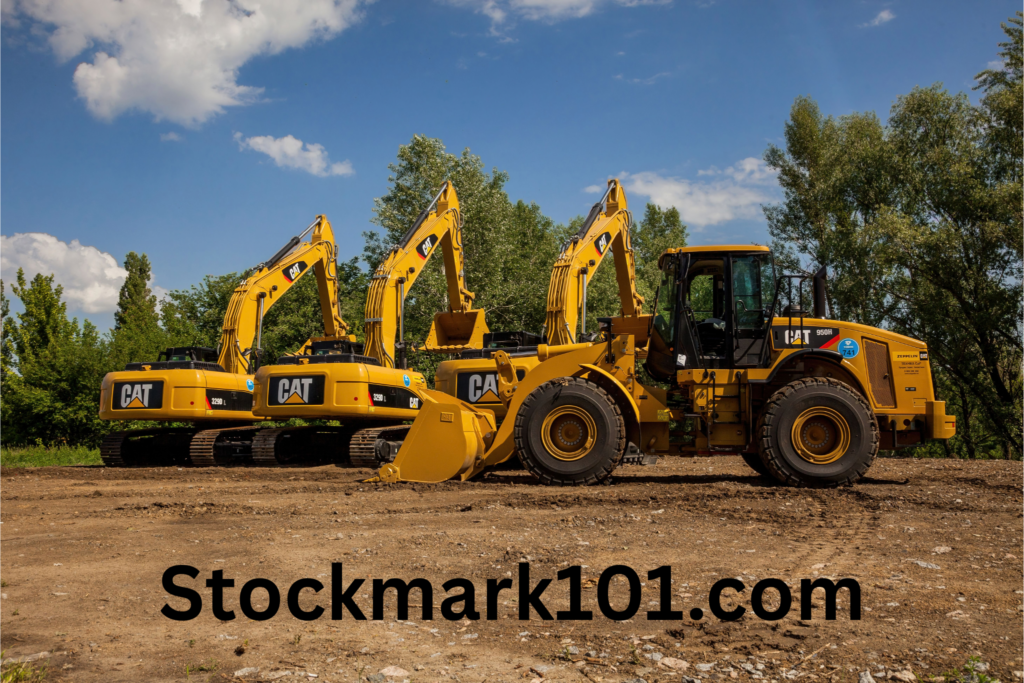
Caterpillar manufactures heavy machinery for the construction, mining, and energy sectors, ranging from excavators and mining trucks to industrial engines and locomotives. The company generates revenue by selling this equipment and providing ongoing maintenance through an independent dealer network, while also offering specialized financing and insurance products.
Since 1925, Caterpillar’s product portfolio has evolved, now comprising 20 brands and generating $67.6 billion in revenue in 2025. It has more than 4 million products with an extensive dealer network of 156 dealers spanning 190 countries.
About This Page
Stockmark101.com is a free educational site focused on explaining how stocks and markets work. Company write-ups reflect general market commentary and publicly available information and are used to illustrate business fundamentals and market behavior — not to provide personalized investment advice.
| Price | $945 | Catergory | Moderate | |
| Market Cap | $435B | Dividend | $6.52 | .70% |
| P/E Ratio | 47.08 | Analyst Avg. | 1-Yr. Target | $944 |
| Consensus EPS Estimate | 1Q | 2Q | 3Q | 4Q |
| 2027 | 6.11E | 7.09E | 7.28E | 7.99E |
| 2026 | 5.54A | 5.60E | 6.28E | 6.43E |
| 2025 | 4.25A | 4.72A | 4.95A | 5.16A |
Historical Volatility categories (Conservative, Moderate, and Aggressive) are based on beta, which measures a stock’s historical price volatility relative to the overall market. Company metrics are current as of the publication date. Historical Revenue and Annual EPS reflect reported fiscal-year results. All information is provided for educational purposes only and should not be considered investment advice or recommendations.
Keys for Success
Caterpillar’s backlog rose to a record $63 billion at the end of 1Q2026, up 79% year over year, supported by all three primary segments, including Machinery and Power & Energy (MP&E). In North America, demand from residential and non-residential construction supports Caterpillar’s construction equipment sales over the long run.
The AI and cloud computing boom has transformed Caterpillar into a crucial “picks and shovels” player for the physical layer of the AI revolution. The challenge for hyperscale AI data centers is securing enough electrical power, and connecting a massive campus to the traditional utility grid can take years due to regulatory hurdles, transmission line shortages, and grid capacity constraints.
To bypass these delays, data center developers are increasingly choosing to skip the grid entirely or build decentralized, on-site power infrastructure to accelerate their time to market, which has sparked an unprecedented surge in demand for Caterpillar’s Energy & Transportation segment. Developers are deploying massive arrays of Caterpillar’s natural gas and diesel reciprocating engines, as well as industrial gas turbines through its Solar Turbines subsidiary, to generate.
Miners are bringing radical changes to mining operations to increase productivity, reduce costs, and improve frontline safety, and are thus increasingly relying on autonomous systems. Electric vehicle demand is also boosting demand for commodities. The global focus on transitioning from fossil fuels to zero-emission energy will require large amounts of commodities, which in turn will boost demand for Caterpillar’s mining equipment. The company plans to triple the number of autonomous trucks in Resource Industries by 2030.
Caterpillar’s cash and liquidity position remains strong, which enables it to invest in growth while returning cash to shareholders. For the first quarter of 2026, enterprise operating cash flow was $1.9 billion. The company has paid higher annual dividends to shareholders for 32 straight years. The company is a member of the S&P 500 Dividend Aristocrat Index.
Keys for Concern
The ISM Prices Index remained in expansion, indicating that raw materials prices increased for the 20th straight month, driven by increases in steel and aluminum prices that affect the entire value chain, tariffs on many imported goods, and higher petroleum-based product prices resulting from the Middle East conflict. Tariffs remain the main variable shaping near-term profitability and quarter-to-quarter comparability. Caterpillar is increasing strategic investment to support long-term growth priorities, but the spending profile can weigh on near-term margins. Higher investment and restructuring spend can cap operating margin expansion.
Mark Notes
U.S. infrastructure investment in roads, bridges, airports, and waterways remains a key opportunity for Caterpillar. Caterpillar saw 1Q2026 revenue growth in all regions, led by 32% in North America, followed by 20% in EAME (Europe, Africa, & Middle Eastern), 5% in Latin America and a 4% rise in Asia Pacific.
Caterpillar recently unveiled Cat AI Assistant, an AI-based solution that allows its customers to engage with Caterpillar’s equipment and portfolio of digital applications in more intuitive and powerful ways. Caterpillar also entered into an expanded collaboration with NVIDIA to drive innovation across industries.
This article is for general informational and educational purposes only. It is not intended as financial advice, investment guidance, or a recommendation to buy or sell any security. The content reflects publicly available information and broad market commentary. Readers should conduct their own research and consult a licensed financial professional before making investment decisions.
Leave a Reply