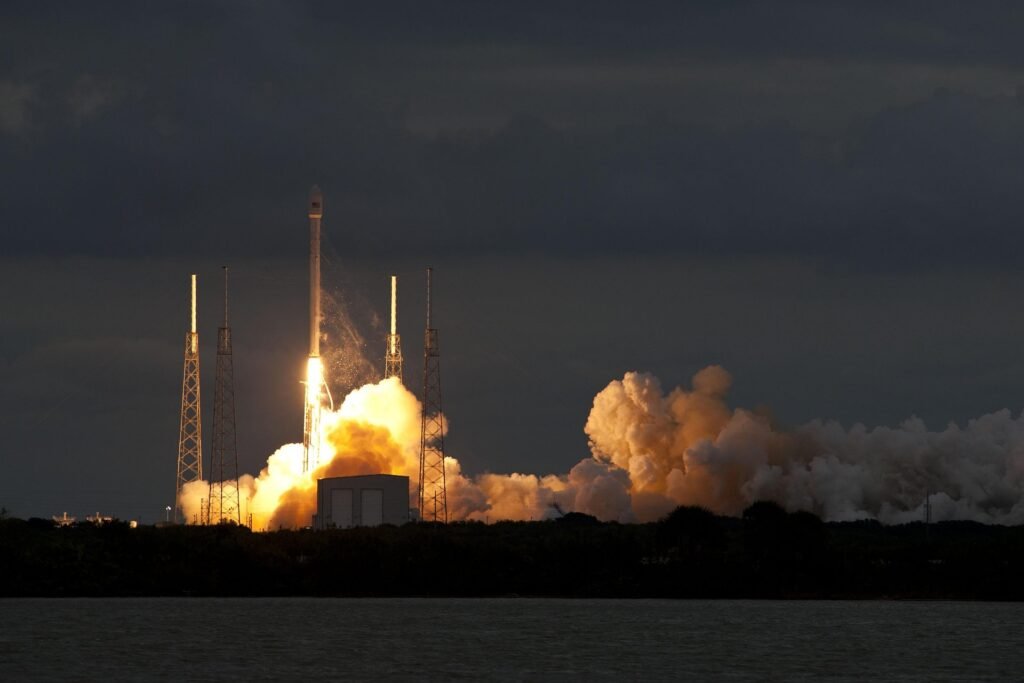
Rocket Labs (RKLB) has positioned itself as the only pure-play space company and a primary competitor to SpaceX, the world’s leading space company. It serves commercial and government customers across communications, Earth observation, science, and national security applications. Launch Services develops and launches rockets such as the “Electron” for orbital and interplanetary missions. Space Systems provides spacecraft design, components, optical systems, and mission services. RKLB is headquartered in Long Beach, CA.
About This Page
Stockmark101.com is a free educational site focused on explaining how stocks and markets work. Company write-ups reflect general market commentary and publicly available information and are used to illustrate business fundamentals and market behavior — not personalized investment advice.
| Price | $117.4 | Category | Aggressive | |
| Market Cap | 68.0B | Dividend | 0.00 | |
| P/E Ratio | – | Analyst Avg | 1-Yr Target | $102 |
| Consensus EPS Estimate | 1Q | 2Q | 3Q | 4Q |
| 2027 | -0.01E | 0.00E | 0.00E | 0.01A |
| 2026 | 0.02E | -0.04E | -0.02E | -0.01E |
| 2025 | -0.12A | -0.10A | 0.01A | -0.07A |
Keys for Success
U.S. national security demand is building durable volume across launch and space systems. Rocket Labs’ backlog after 1Q2026 has swelled to more than $2 billion after several new and significant contract wins, with management expecting about 37% to convert within 12 months. The company sold 28 new launches in Q1 2026, nearly matching its entire 2025 performance.
The company generated $200 million in revenue in the quarter and posted a $12 million EBITDA loss, better than Wall Street’s consensus loss of $190 million. Rocket Lab needs to be viewed as a long-term growth story, not a quarter-to-quarter standout. And the company’s forecast for the future, though not surprising, was encouraging
Rocket Lab shares could also benefit as anticipation over its Q4 “Neutron” reusable rocket launch grows. Neutron is designed to compete directly with SpaceX’s “Falcon 9” and is expected to generate more than 6x the revenue per launch as its current “Electron” rocket. Additionally, RKLB continues to diversify into the defense business and was recently awarded a $190 million national security contract.
In 2025, Rocket Lab flew three HASTE hypersonic missions and signaled additional HASTE missions in 2026, aligning with Golden Dome priorities. In 2025, Electron was the second most frequently launched orbital rocket. As of December 31, 2025, the company had delivered over 200 spacecraft to orbit across 75 successful missions and had flight hardware operating on more than 1,800 missions. Electron achieved 21 launches in 2025 with 100% mission success.
The company is not yet profitable, but has its balance sheet under control. Rocket Lab used $77 million in cash in the quarter, finishing the period with $1.48 billion in the bank. At that rate, the company can continue to invest in itself for some time now.
Keys for Concern
Neutron’s first launch target has been delayed to the fourth quarter of 2026 following a Stage 1 tank rupture, extending development timelines. High R&D spending, capital expenditures, and cash burn during testing and qualification phases could prolong losses and delay the company’s path toward adjusted profitability.
The company has reiterated that SDA revenue pacing is frequently constrained by subcontractor deliveries, with optical terminal availability cited as an industry bottleneck. A significant portion of the backlog is tied to U.S. government programs, increasing exposure to budget cycles, procurement timelines, and policy decisions. Regulatory approvals add further uncertainty.
Mark Notes
As Rocket Lab transitions from a niche launch provider to a vertically integrated space powerhouse, the stars are finally aligning for investors. Defense demand, backlog visibility, scalable launch cadence, vertical integration, and liquidity support growth. U.S. national security demand is building durable volume across launch and space systems. Rocket Labs’ backlog has led to a consensus estimate of profitability in late 2027 – a difficult feat for a space company.
New to investing? These explanations may help:
Semiconductors: Thriving in a Turbulent Market
Growth vs. Value: Why Some Stocks Move So Differently
This article is for general informational and educational purposes only. It is not intended as financial advice, investment guidance, or a recommendation to buy or sell any security. The content reflects publicly available information and broad market commentary. Readers should conduct their own research and consult a licensed financial professional before making investment decisions.
Leave a Reply